Gracias VRS, your premier Tri-Lingual provider of Video Relay Services, will soon change our name to Global VRS!
You will continue to receive the same incredible services in ASL, English and Spanish! But we feel the GLOBAL name better represents the all inclusive services that we provide to the diverse needs of our Deaf and hearing consumers! For more on what Global will represent, keep an eye out for our Global VRS Launch Commercial, “We Are Global!” coming soon!
Whether you use ASL, Spanish, or English GLOBAL represents the very best in VRS!
Gracias is THRILLED to announce that we have gone mobile with our premier VRS product, GX-Pro! You can now download our mobile app GX-Pro Mobile from your Android device on Google Play. You will get our same great ASL, Spanish, and English interpreting service ON THE GO!
We recommend using GX-Pro Mobile on wi-fi so that you can get the best quality video experience possible. So what are you waiting for?! Download GX-Pro Mobile TODAY and check us out at home, the coffee shop, and the library, at work or at school!
Remember you can always download GX-Pro for your PC by going to www.graciasvrs.com and clicking Download GX-Pro Quality VRS without limits!
The release of our Android app is the first exciting announcement of the year, but there is MUCH more to come in 2013! Make sure that you are following us on Facebook and Twitter for the most current news and updates.
If you have any questions about our service or GX-Pro Mobile, please feel free to contact out Customer Support team at help@graciasvrs.com.
Early tomorrow morning on February 13th, 2013 we will be performing a routine update to our system in order to deliver the best possible product to our customers. The update will happen between 2:30 A.M. and 3:30 A.M. EST and should last approximately 10 minutes. It is our sincere desire to provide you with excellent service and we are grateful for your loyalty!
Gracias VRS experienced a brief service impairment on Thursday, February 7, 2013 between 7:57 PM and 8:31 Eastern Time. Information received from the Company’s platform provider indicates that there was an “H323 attack” consisting of a high volume of fraudulent calls directed to GraciasVRS’ relay services platform, rendering the Company’s H323 gateway incapable of processing calls. A number of other entities, not necessarily relay service providers, were similarly impacted according to the platform provider. Some 18 legitimate calls were determined to have been received during this time via the Company’s gateway, but could not be processed. Incoming calls to Gracias VRS’ platform that were not routed via the H323 gateway were unaffected. Public access to the H323 gateway was immediately restored following the attack and the Company’s platform provider is investigating the basis for the attack.
We thank you for your patience and understanding.
Gracias VRS
An FCC elegibible provider and a division of ASL Services Holdings, LLC
One year ago today, Gracias VRS was granted provision certification from the FCC and became an eligible provider of VRS services. We are very proud of what we have accomplished in providing for the VRS needs of the Deaf/Hard of Hearing community and Latino and English speaking communities. We are very grateful and humbled by the support that our customers have given us over the last year and we look forward to serving your needs for many years to come! We welcome you to take part in our celebration by sharing your experiences you have had in using our service and interacting with our amazing interpreters by leaving a comment below.
Over the next year Gracias VRS will expand services to ensure we are continuing to meet the needs of all of our customers. Look for exciting new updates very soon!
We cannot thank you enough! HAPPY ANNIVERSARY GRACIAS VRS!
iDeaf News took the time to interview Gregory Hlibok with the FCC on the latest VRS reforms being proposed. It is important as VRS users that you watch this information and share your feelings with the FCC. You can click here http://apps.fcc.gov/ecfs/upload/display?z=iz9on to write to the FCC and comment on this important decision!
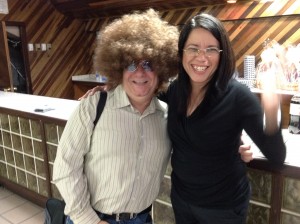
The morning of June 29th, 2012 started in a very special manner. An unannounced T-Storm destroyed the electrical system in Puerto Rico leaving 85% percent of the population without power. Nevertheless the electrical system was repaired and the electricity came back. It was then that the Gracias Vrs Team started decorating the “Mayor’s Room” (Salon Alcalde) within the Coliseo Rubén Rodríguez in Bayamón.
The Staff
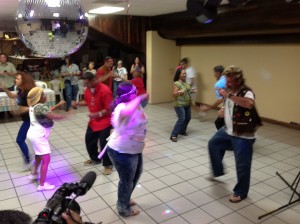
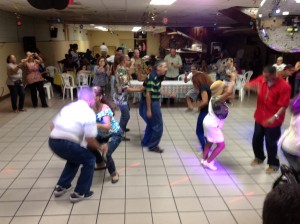
At 5:30 pm the Deaf started arriving. There was so much enthusiasm and joy in the air. More than 110 people from the Deaf community attended the event. Gracias VRS Team was ready with food and refreshments for them as well as music and a Retro decoration of the room. Many started dancing and enjoying themselves to the rhythm of the music provided by the Municipality of Bayamón and it’s mayor, Ramón Luis Rivera.
People at the Dance Competition
The night started with a welcome message from Gilberto García Director of Asl Services Latino, followed by a message from our host, Mr. Amilcar López, Library Director and responsible to provide accessibility to people with Disabilities within the municipality of Bayamón. After his message the Gracias VRS Retro Raffle was started. Beautiful baskets were prepared full of goodies as gifts for the people at the party.
Dance Competition
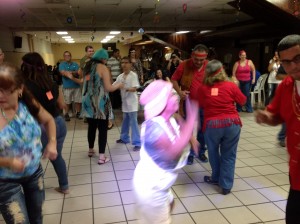
The moment everyone was expected arrived. The dance couples had their numbers and the judging panelwas ready and in position. the 15 dance couples started to dance and after 20 intense minutes of dancing the evaluating team picked the 5 finalist couples. It was extremely hard to reach a consensus among the judges because all the dance couple were so good. After a while the judges gave their verdict and chose the first, second and third position winners.
Dance Contest
Before giving the winners their gifts, Mr. Martín Ortiz, Gracias VRS promoter talked to the people present about their experiences and excellent quality service that Gracias VRS provides. At that point the male partners of the dance couple got a special gift prepared for them and the female counterpart got beautiful baskets full of beauty, personal grooming, wines, chocolate and promo items courtesy of Gracias VRS.
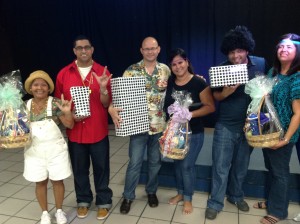
Winners of the dance competition. From left to right third,second and first price winners.
Again, another raffle took place while the judging panel got assembled to start the costume competition. Each person did a short presentation dance before the judges and the winner was chosen and a basket given to him. After the costume competition another basket was raffled. The people there continued sharing, eating and drinking the delicious fruit juice specially prepared for the occasion. At 10 p.m. the party ended as we thanked all the guests reminding them to use Gracias VRS and to be watching for other events and activities.
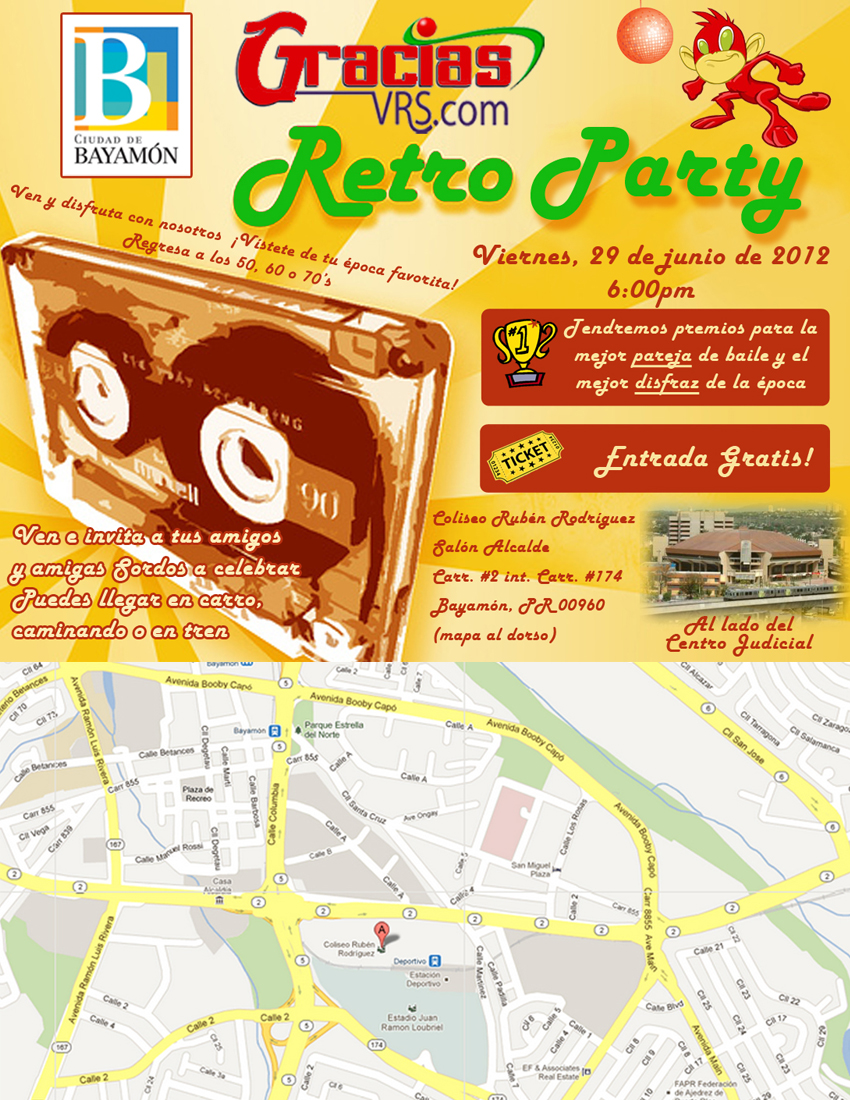
You are invited to our first Retro Party in Puerto Rico. Come dressed like the 50′s, 60′s or 70′s and enter the competition for best costume. We will also have our famous dance competition. There will be prizes awarded to first, second and third places in both categories, plus a raffle, gifts and much more. The entrance is free. Come and bring your Deaf friends with you to this wonderful event. The Retro Party will be held at the Ruben Rodríguez Coliseum, Salón Alcalde Room june 29th starting at 6:00 pm. There is parking available or you can come by train at stop “Deportivo”. Join us for this spectacular summer event powered by the one that is ALWAYS WITH YOU! GRACIAS VRS.
We want to bring to your immediate attention to this serious concern that could impact our Deaf truck drivers and related jobs!
Deaf and hard of hearing truck drivers need your support! We need your help to tell the U.S. Department of Transportation that deaf and hard of hearing people should be permitted to drive trucks!
For the first time in history, the U.S. Department of Transportation (DOT) is considering the applications for exemptions from the Commercial Drivers Licenses (CDL) hearing requirements for 45 deaf and hard of hearing individuals submitted by the National Association of the Deaf (NAD). The U.S. DOT is requesting comments from the public, so show your support now.
The physical qualification requires individuals to prove they can “first perceive a forced whispered voice in the better ear at not less than 5 feet with or without the use of a hearing aid” or “not have an average hearing loss in the better ear greater than 40 decibels at 500 Hz, 1,000 Hz, and 2,000 Hz with or without a hearing aid . . .” (see 49 C.F.R. § 391.41(b)(11) for more details).
KISSIMMEE, Fla., June 1, 2012 – Kissimmee Utility Authority today released its 2012 Osceola Hurricane Handbook, a free comprehensive preparedness guide offered annually to Osceola County residents.
The 40-page handbook has been revised, updated and enhanced by the utility to provide residents with the most current and up-to-date information available. The guide includes information on emergency shelters, evacuation routes, generator safety and power outage restoration as well as helpful telephone numbers, a disaster supplies checklist and a hurricane tracking chart.
Printed copies of the handbook will be available, beginning June 11, in the lobby of KUA’s customer service center at 1701 W. Carroll Street in Kissimmee.
To receive a copy of the printed handbook by mail, residents should contact KUA at (407) 933-9838 or by e-mail at hurricane@kua.com.
Founded in 1901, KUA (http://kua.com) is Florida’s sixth largest community-owned utility providing electric and telecommunication services to 64,000 customers in Osceola County, Fla.
 Reviews
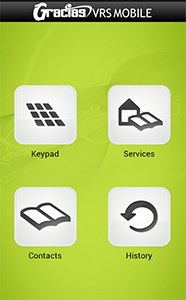 Gracias is THRILLED to announce that we have gone mobile with our premier VRS product, GX-Pro! You can now download our mobile app GX-Pro Mobile from your Android device on Google Play. You will get our same great ASL, Spanish, and English interpreting service ON THE GO!
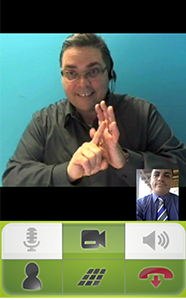 Remember you can always download GX-Pro for your PC by going to
  One year ago today, Gracias VRS was granted provision certification from the FCC and became an eligible provider of VRS services. We are very proud of what we have accomplished in providing for the VRS needs of the Deaf/Hard of Hearing community and Latino and English speaking communities. We are very grateful and humbled by the support that our customers have given us over the last year and we look forward to serving your needs for many years to come! We welcome you to take part in our celebration by sharing your experiences you have had in using our service and interacting with our amazing interpreters by leaving a comment below.